Channel
Interviewed Person
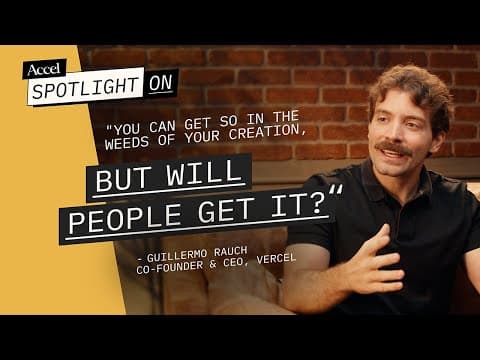
Guillermo Rauch
"The AI SDK is now the second largest AI module in the JavaScript and TypeScript ecosystem, only second to OpenAI."
"There's going to be millions or billions of agents. There's not going to be one agent to rule them all."
"v0 has switched models six times since its inception. So gateways can be the great normalizers."
"We announced our AI gateway is now one of the largest routers of AI tokens worldwide."
"You prototype really quickly with visual building tools, but then when they become a part of your critical business, you have to treat them as any other kind of software."
Uh you recently crossed the 10-year mark, I believe, with Verscell. Um and it seems like maybe you're gearing up for the next 10. Um any reflections on kind of the first 10? Yeah, broadly. I think the first 10 years of Vercel are reflective of a large transformation that's happening in the industry. The last 10 years were about pixels. broadly user interfaces that need to load really fast that optimize for better conversion. 10 blue links on Google searches and optimizing for SEO. The next 10 years will be the
10 years of tokens and agents going from pages to agents is a sound bite and it'll be marked by new kinds of uh software engineering approaches. uh perhaps moving from developer experience to the agentic developer experience. You know, companies like Verscell have grown out of creating the best possible DX, the best possible APIs and and uh succinct code snippets that human
developers would adopt. The next 10 will be marked by appealing to agents. Uh there's the Y cominator uh meme of make something people want. I think we'll be transitioning into make something agents want. Um, and yeah, in the next 10 years we'll be around agents which perhaps don't have the user interfaces that we've been accustomed to till now and less so much on rendering a bunch of pixels and UIs and clicks and more on autonomy and uh intelligence at your
fingertips. Yeah. So, you wrote a great blog post, highly recommend checking it out u about the AI cloud um kind of your Yeah. you Verscell has been known historically as uh providing this kind of front-end focused cloud. What is different about the AI cloud? Why are why are you kind of defining this as the next phase of Versail? Yeah, if you look at the history of the cloud with, you know, AWS, Amazon web services,
things were quite different back then. The thing that was hard to do was creating highly performant web experiences. Amazon.com showed us that for each 100 millisecond of page speed up they would get a 1% improvement in conversion rates. The kinds of software that people will be creating in the future are less uh you know motivated by rendering some pixels on the screen really fast. We're noticing that the compute that people are devoting to creating these kinds of applications are spending a lot of time thinking they're
streaming interfaces to clients. They're hyperpersonalized and contextual. So my argument is that the hello world application of the cloud will no longer be a web site or web application at least in the form that we've been creating them till now. Another large transition is that even though the cloud has been so successful at sort of virtualizing the data center and and automating the the the provisioning of compute and and and resources, it's also been a huge source of problems. The
average experience of any of your clouds is that you get paged. Recently, I went viral on X because my Internet of Things mattress woke me up in the middle of the night. uh because USC one went down when when the when when the light by the way I did it like just uh it was 3:00 a.m. and my mattress is warm and then I open the app and it tells me AWS is down and and and so of course there's ways and Verscell does a lot of them by
default to create no single points of failure automatic recovery and things like that but the average experience of the cloud is still that you get paged that you have to pay for really expensive dashboards of error rates that you have to configure and wire up alarms and page schedules for your team and Slack integrations. And I think we'll be going into a world of full autonomy of the cloud. I call it the self-driving car moment of the cloud. And I call it