Channel
Interviewed Person
Conferences
Vercel
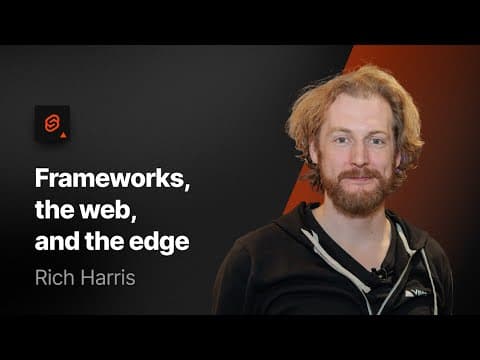
Interviewed: Rich Harris
[Music] [Applause] Hello, Vercel. Today we're going to be talking about engineering your site for answer engine optimization. My name is Dylan Babs and I'm the CTO and co-founder of Profound. Our goal is to help brands win in the age of generative search. What that means is we're building a platform to help companies understand and control their visibility in answer engines such as
chatbt perplexity and Google AI mode. Today we're going to be talking about how answer how answer engines work, some key strategies you can employ as a developer to win in answer engine optimization, as well as how profound can help you out. And we're also going to be releasing two key new features to also help you with connecting Verscell to Profound. Let's dive in. The platform shift towards answer engines has already begun. LLMs are no
longer just this developer forward tool that we use to help generate code or improve our workflows. They're starting to enter the mainstream as a new consumer product and people are starting to actually change their traditional search queries into these answer engine queries. So people might traditionally look up product discovery or find new information with Google, but they're now doing that in things like chatbt and perplexity. There's over 500 million weekly active users in chatbt as well. Let's dive into
the user experience about how these two work. On the left, we have traditional search. Someone would put in a query about looking up some compliance software and then you would get a list of 10 blue links with a description and a title on the page. And it's really your job as the user to actually go figure out which link you want to click on. And then you navigate to the page and you actually have to find the information yourself. And if you're lucky, you'll get that info. But sometimes it requires going back to a
second or a third page. And now if we look on the right, if we contrast that with an answer engine, it's really quite a magical experience. You enter a query and then the answer engine is going to go pull from a wide variety of sources on the internet and then go give you a nice concise cohesive response. And kind of the biggest difference here that you might notice is that you get everything you need directly in the response of the answer engine. And so this represents kind of the future that we're heading
towards. We call this the zeroclick future because users no longer need to actually click on your website to get the information. It's going to come summarized in this one response. In fact, Hrefs, which is a traditional SEO company, recently published research seeing that the top sites are actually decreasing 34.5% in terms of total traffic and clicks due to this new emergence of the zeroclick internet. That means as developers of
websites, we're actually going to expect to see search uh traffic actually decreasing because of this. And then also for those of us who run e-commerce sites or work in commerce, um this is also going to play a major factor here as well. Our research here at Profound shows that by 2027, we expect answer engines to drive more than 2.5 trillion in commerce annually. So, this is something that you really need to be thinking about as a developer and I'm going to help you optimize your site for
it and prepare for this future. A lot of you all are probably familiar with SEO. I mean, being here at the Verscell conference, I'm sure we've all really spent a lot of time server side rendering our React to really make it effective for SEO. AEO and SEO are actually kind of the same goal, but it's a little bit of a different game. With SEO, you're really fighting to get into the answer. And with SEO, you're only really fighting to get in those top 10 links. So really now to optimize your