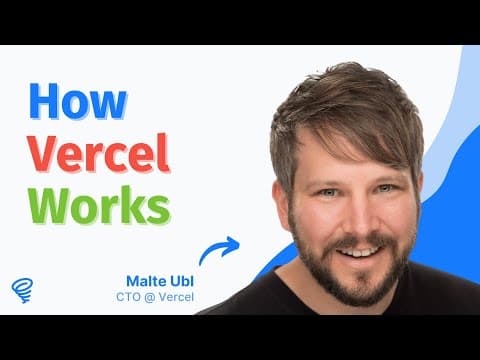
Playing from timestamp
Video starts at 7:34
Channel
Interviewed Person
Guillermo Rauch
"The best thing that could happen to Next.js is for the pie to get so large that we're just really happy to have a slice."
"I want the web to actually be the winning and dominant application platform of the future better than any mobile application that's in the App Store ecosystem could be."
"Every person on the planet is carrying a JavaScript running computer or virtual machine."
"The stock that I picked was JavaScript because it had this incredible privilege of it can run on the client."
"When you learn this technology, it should be a technology that lasts you a lifetime."
I know that you recently hosted a great episode on complexity. One of the key challenges that companies like Vercel have, and I'm all for it because it's been the calling of my life, is what I call the progressive disclosure of complexity. So I'm building a platform that should not be intimidating for your first line of code, and gives you the superpower that you could be one day a top 30 internet website with the same infrastructure, with the same tools, with the same access.
When you learn this technology, it should be a technology that lasts you a lifetime. It should be a skill that gets you, if you want to, in a really good place in the global job market. Or it should be a technology that's also fun. Hey, Luca here. Welcome to a new episode of the Refactoring Podcast, where every two weeks we interview a world-class tech leader and we talk about the future of software engineering. Today's guest is Guillermo Rauch, who is CEO and founder of Vercel
and who needs truly no introduction. With Guillermo, we talked about his journey in tech, from a small-town in Argentina to successful open-source developer to CEO of a billion-dollar company. Then we covered the unique Vercel model, which combines open-source and commercial work. And finally, we discussed the future of AI, engineers, open-source and software engineering at large. So let's dive right into it. Hi Guillermo, welcome and thank you so much for being on the show today.
Thank you, Luca. Super excited to be here. So Guillermo, you are the CEO and founder of Vercel, which needs very little introduction to anyone working in tech. But I find it hard to define as a company because you do so many things. You provide hosting, but you also work on web frameworks, and more recently you created also v0, which is one of the most popular AI coding tools out there. So what's your elevator pitch for what Vercel is and what it does?
Yeah, at a very high level, we simply create the tools and infrastructure to create and ship the best experiences possible on the web. So like you said, we host websites, we host web applications. But one of the things that I always sort of project into the world is I want to be able to go to a website, and it's so fast, so innovative, so dynamic, so personalized, that I must then think it's hosted on Vercel.
So our goal in this world is not to just create average experiences, it's to create the highest quality possible experiences. And we believe that in order to do that, you have to create amazing tools. So a lot of cloud companies like AWS and Azure have created amazing low level infrastructure. But then it's up to the company or the individual to assemble the frameworks, the tools, the compilers, the bundlers, all this very advanced technology, right, to then create an application.
And I thought when I started this company, I'm going to take on more of the problem. I'm going to create an end-to-end platform, the complete platform for the web. And that concretely became Next.js, which is a super popular open source web framework based in React and the cloud infrastructure piece, which is in order to make a great application worldwide that is fast in Italy and is fast in the United States
and is fast in Argentina, we have to deploy globally, which is also very, very difficult to do. So to manage global infrastructure, the caches, the invalidation, the propagation, it's always one of the hardest problems in computer science. So let us take the burden of distributing the bits worldwide and you bring your ideas and creativity. And in that context also, we created v0, which is an artificial intelligence tool, the idea being you just prompt in English or Italian or Spanish